Power station vs generator: the real differences
A power station is a silent battery you can run indoors; a gas generator is a fuel engine that sustains heavy loads for days. Pick by the load and the location, not by the price tag.
For camping, RV quiet hours, indoor backup and electronics, the battery wins on every quality-of-life measure. For long outages with heavy appliances, or job sites that chew through kilowatt hours, fuel is still the cheaper way to buy raw sustained output. Many serious off-grid setups end up owning both and using each for what it is good at. How we compare and decide: our method.
| Factor | Power station (battery) | Gas generator |
|---|---|---|
| Noise | Near-silent (a fan at most) | Engine noise the whole time it runs |
| Indoor use | Safe indoors, no exhaust | Never indoors: exhaust contains carbon monoxide (CPSC guidance: outdoors only, away from windows) |
| Energy source | Recharge from wall, car port or solar panels | Gasoline or propane, bought and stored |
| Sustained heavy loads | Limited by battery size; big capacity costs a lot | Runs as long as you refuel; the strength of the category |
| Running cost | Near zero; solar refills are free | Continuous fuel cost, rising with load |
| Maintenance | Essentially none | Oil, filters, carburetor, fuel stabilizer, exercise runs |
| Instant readiness | Push a button, even indoors at 3am | Fueling, choke, cord or starter, outdoors |
| Lifespan driver | Battery cycle rating (LiFePO4 chemistry is the number to check) | Engine hours and how well it is maintained |
What they both do
Both put household AC power where the grid is not: campsites, RVs, job sites, and home backup during an outage. The difference is when the energy is made. A power station is a way to store electricity before you need it; portable generators make it on the spot, which is why an extended power outage favours the engine and a quiet weekend favours the battery.
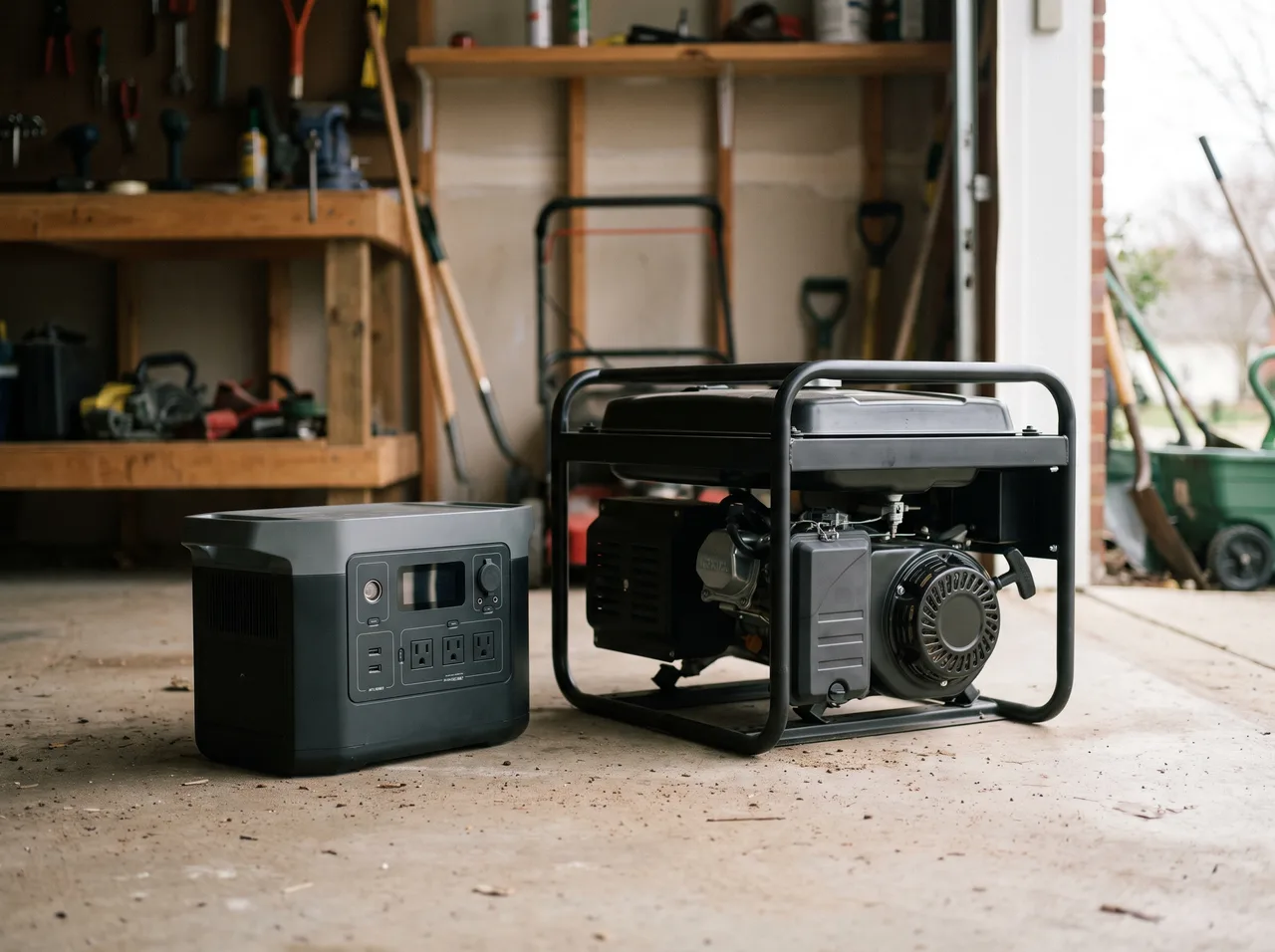
A power station stores energy in lithium cells ahead of time; add solar panels and the combination is what stores sell as a solar generator. A gas generator converts fuel to electricity on demand and keeps going for as long as you keep pouring fuel in.
Neither is "better"; they solve different halves of the same problem.
Where the power station wins
- Silence. No engine, no drone, no quiet-hours argument at the campground. This alone decides it for most campers.
- Indoor safety. No exhaust means it runs beside the bed, in the tent vestibule or inside the rig. A fuel engine can never offer this.
- Zero maintenance. No oil, stale gas or carburetor gum, and none of the regular maintenance an engine needs to survive being stored between trips. It holds a charge in storage and starts with a button.
- Free refills. Sun on a panel costs nothing, and the car can top it up while you drive.
- Electronics-friendly power. Modern stations output clean sine-wave AC that laptops, CPAPs and camera batteries are happy with.
Where the gas generator wins
- Raw sustained output. Heavy loads for days come down to fuel cans, not battery banks. Watt hour for watt hour, stored fuel is cheap.
- Upfront price per watt. A fuel engine of a given output usually costs less to buy than a battery of the same output.
- Weather-independent. No sun needed. A jerry can works at midnight in a storm.
- High-draw appliances. Central AC, well pumps, big power tools: sustained kilowatt loads are the engine's home turf.
The cost question, honestly
Upfront, fuel engines are cheaper per watt. Over time it depends entirely on how you use them. Light, frequent use favors the battery: no fuel, no oil, no service, and solar refills cost nothing.
As a real anchor, a 300W-class power station bundled with a 100W panel sells for $397, marked down from $497, on My Patriot Supply's store (prices verified September 24, 2026), while its "fuel cost" for a decade is zero.
Heavy sustained use favors the engine: buying enough battery to match a week of high loads costs far more than a generator plus fuel. Run your own week through both models before deciding; the worth-it guide's sizing math is the same arithmetic.
How to pick in one minute
Ask three questions. Where will it run? Anywhere near people sleeping, or indoors: battery, full stop. What is the biggest load? Electronics, fridge, lights, CPAP: battery. Central AC or a well pump for days: engine. How long between refills? If daytime sun or a drive can top you up, the battery loops forever; if you need three cloudy days of heavy power, fuel wins.
Most RV campers land on the battery, most whole-house preppers on the engine, and plenty of off-gridders on both.
If that lands you on the engine, the choosing carries on inside the category. Our guide to the dual fuel inverter generator covers what those two words each buy you, what the makers' own tables take off when you run on propane rather than gasoline, and the second derate their manuals apply for altitude.
Common questions
What is the difference between a power station and a generator?
A portable power station is a big rechargeable battery with an inverter: silent, fume-free and safe to use indoors, refilled from a wall outlet, a car port or solar panels. A gas generator is a fuel-burning engine that makes electricity as long as you feed it: louder, exhaust-producing and outdoor-only, but able to sustain heavy loads for days if you keep fuel coming.
Can a power station run indoors?
Yes, and that is its single biggest advantage. A battery power station produces no exhaust, so it can sit next to your bed running a CPAP or inside an RV overnight. A gas generator can never do this: its exhaust contains carbon monoxide, and safety agencies such as the CPSC warn that generators must only run outside, far from windows and doors.
Is a power station cheaper than a gas generator?
Upfront, usually no: watt for watt, a gas generator is cheaper to buy. Over time the picture flips for light and medium use, because a power station has no fuel cost, no oil changes and near-zero maintenance, and solar refills are free. Heavy sustained use reverses it again, since batteries big enough for days of high loads cost far more than the gas to run an engine.
Can a solar panel replace fuel for a power station?
For daily light-to-medium loads, yes. Panels refill the battery during daylight, so a correctly sized station plus panel can loop indefinitely in sunny weather, which is exactly how RVers use them off-grid. The catch is weather and math: cloudy days cut input sharply, so you size the panel and battery with reserve instead of assuming every day is sunny.
Which is better for RV camping: a power station or a generator?
For most RV campers, a power station wins: it is silent during quiet hours, legal to run anywhere including inside the rig, and refillable from solar or the alternator while driving. A gas generator still makes sense for rigs running rooftop air conditioning off-grid for long stretches, a sustained heavy load that outruns affordable battery capacity.