Watts to amps: the converter, and what it means for your battery
We may earn a commission if you buy or book through the links on this page. How we make money
Short answer: to convert watts to amps, divide watts by volts. On alternating current, divide by the power factor too. To go the other way, amps to watts, multiply instead. A 600 watt load on a 12 volt system draws 50 amps; the same 600 watts on a 120 volt outlet draws 5 amps.
That is the textbook answer and every converter on the internet gives it. The one below also answers the question that actually matters off-grid: when you run an AC appliance from a 12 volt battery through an inverter, the battery-side current is far higher than the AC-side number, and conversion losses make it higher still. Method: how we evaluate.
The converter
The formulas, written out
- Watts to amps, DC: amps = watts ÷ volts
- Watts to amps, AC: amps = watts ÷ (volts × power factor)
- Amps to watts, DC: watts = amps × volts
- Amps to watts, AC: watts = amps × volts × power factor
- How to calculate watts from a label: watts = volts × amps. Given any two of the three, the third follows.
Power factor is the part worth understanding rather than guessing. It describes how much of the current is doing useful work on an AC circuit. For purely resistive loads such as heaters, kettles and incandescent bulbs it is effectively 1, so the AC and DC formulas give the same answer. Motors and compressors run lower.
We deliberately do not print a table of typical values here, because the number that governs your appliance is on your appliance: check the nameplate, and if it lists both watts and amps at a stated voltage, it has already told you its power factor.
Why 12 volts changes everything
This is the single most useful consequence of the formula for anyone with an RV or an off-grid setup. Because amps are watts divided by volts, dropping the voltage by a factor of ten multiplies the current by ten for exactly the same appliance.

Practically, that is why a 12 volt system needs heavy cable, proper fuses and short runs, and why voltage drop is a live concern on a long DC run when it is an afterthought at 120 volts.
It is also the reason many larger off-grid builds move to 24 or 48 volts: the same power at four times the voltage is a quarter of the current, and everything downstream gets easier. You can see that trade instantly by tapping the 24V and 48V presets above.
The conversion almost every calculator skips
Here is where a generic converter stops being useful off-grid. Suppose you run a 1,000 watt AC appliance from a 12 volt battery through an inverter. The AC-side answer is about 8.3 amps at 120 volts. That number is correct and completely irrelevant to your battery, which is being asked for roughly 83 amps at 12 volts before losses.
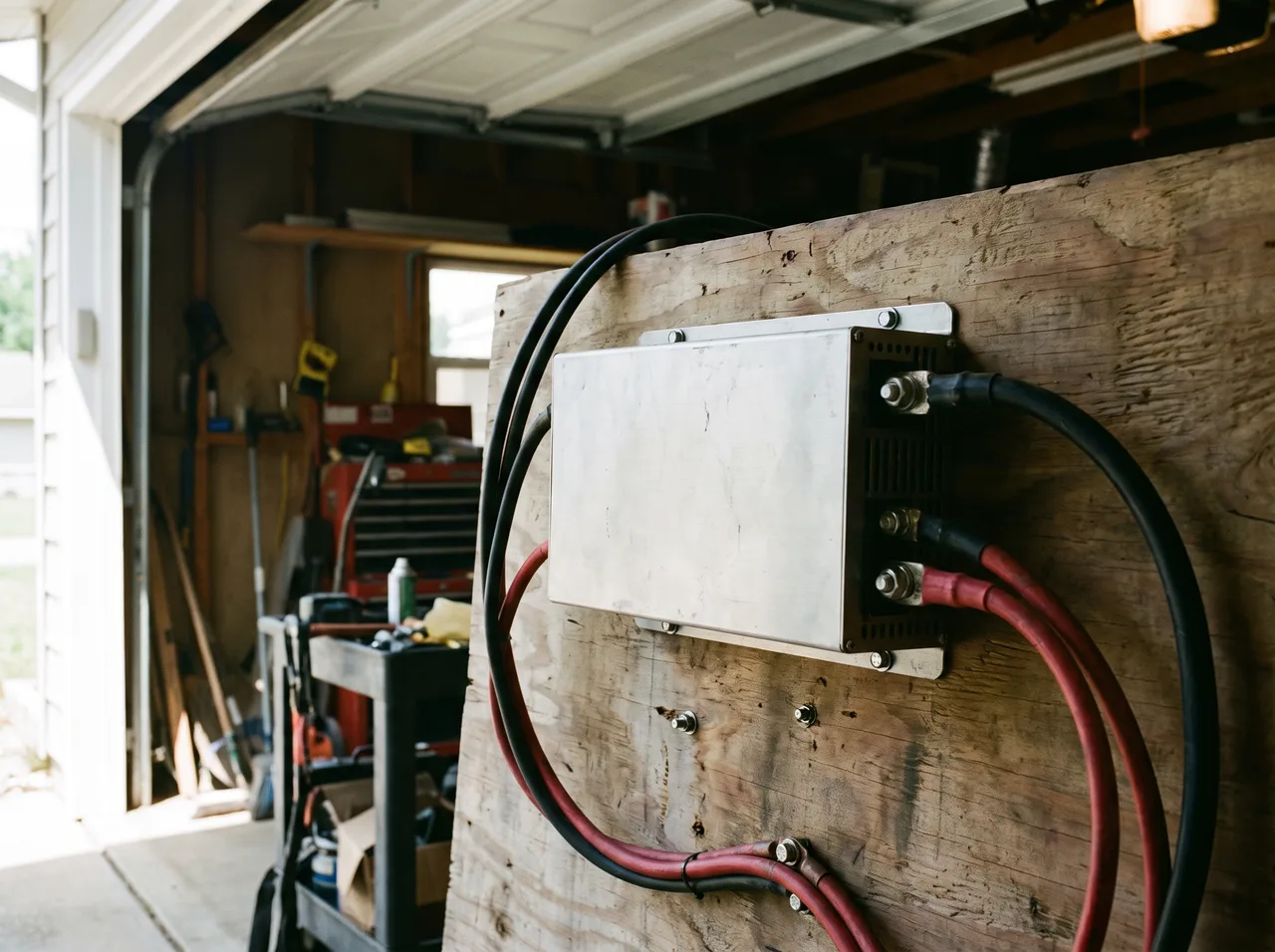
Then add the inverter itself. Converting DC to AC is not free, and this site works to a published efficiency band of roughly 85 to 90 percent, the same figure we use in our Grid Doctor 3300 review and in what a solar generator actually is. That pushes the real battery-side draw to roughly 93 to 98 amps.
The converter above shows this range automatically whenever you enter an AC voltage, because it is the number that decides your cable, your fuse and how fast your bank empties.
Treat that band as an estimate rather than a specification: real efficiency varies with load and with the specific inverter, and a unit running well below its rated output is often less efficient than one working in its comfortable middle.
From amps to amp-hours, which is what a battery sells you
Amps tell you the rate. Amp-hours tell you the quantity, and that is what a battery is rated in. Multiply the current by the hours you run something and you have the amp-hours that leave the bank. That is why the optional hours field above exists: enter it and the converter reports the amp-hours at your chosen voltage as well as the current.
One warning before you size anything from that figure, because it is the mistake this calculation invites. The amp-hours on a battery label are not all yours to use.
How much of the rating you can actually take, and why lead acid and lithium answer that differently, is the subject of our guide to the best RV battery for boondocking, with the chemistry behind it in LiFePO4 explained and what is an AGM battery.
If what you really want is to know how long a specific power station will run a specific appliance, our what will it run calculator does that job directly against real capacities.
See the power station we benchmark against
Common questions
How do you convert watts to amps?
Divide watts by volts. On direct current, amps equal watts divided by volts, so a 600 watt load on a 12 volt system draws 50 amps.
On alternating current you also divide by the power factor, so amps equal watts divided by volts multiplied by power factor. Power factor is 1 for purely resistive loads such as heaters and kettles, and lower for motors and compressors, which is why the appliance nameplate is the authority rather than a rule of thumb.
How do you convert amps to watts?
Multiply amps by volts. On direct current, watts equal amps multiplied by volts, so 5 amps at 12 volts is 60 watts.
On alternating current, multiply by the power factor as well: watts equal amps multiplied by volts multiplied by power factor. The converter on this page runs the calculation in both directions and lets you set the voltage and power factor yourself.
How do you calculate watts?
Watts equal volts multiplied by amps. That single relationship is the whole basis of every conversion on this page, and it is worth committing to memory because it also unlocks watt hours, which is watts multiplied by hours and the unit that actually describes battery capacity.
If a label gives you any two of volts, amps and watts, you can always find the third.
Why does the same appliance draw ten times more amps at 12 volts?
Because amps are watts divided by volts, so lowering the voltage by a factor of ten raises the current by the same factor. A 1,200 watt load is 10 amps at 120 volts but 100 amps at 12 volts.
This is not a quirk, it is the reason RV and off-grid direct current wiring uses much thicker cable and larger fuses than household wiring for the same appliance.
How many amps does a 1000 watt inverter draw from a 12V battery?
More than the simple division suggests, because inverters are not lossless. A 1,000 watt AC load divided by 12 volts is about 83 amps in theory, but after conversion losses the real battery-side draw is higher. Using this site’s published inverter efficiency band of roughly 85 to 90 percent, expect somewhere near 93 to 98 amps.
The converter above shows that range for whatever load you enter.