What is an AGM battery? Sealed lead acid, and what it does not fix
We may earn a commission if you buy or book through the links on this page. How we make money
Short answer: an AGM battery is a sealed lead acid battery in which the acid is held in a glass mat instead of sloshing about as free liquid. Victron's datasheet puts it exactly: AGM stands for Absorbent Glass Mat, and the electrolyte is absorbed into a glass-fibre mat between the plates by capillary action. That single change buys you no watering, a sealed case, freer mounting and strong high-current delivery.
What it does not buy you is an escape from lead acid's central limit. Victron publishes cycle life for its own AGM Super Cycle battery at at least 1000 cycles at 40 percent depth of discharge, at least 700 at 60 percent and at least 300 at 100 percent.
Same battery, three different lifespans, decided entirely by how hard you use it. That table is the most useful thing on this page, and it is why AGM and lithium get chosen for different jobs rather than one replacing the other.
Every figure below comes from Victron's or Trojan's own documents, read on August 3, 2026, and named in the text. Method: how we evaluate.
What is an AGM battery, precisely
Start one level up. Victron's datasheet defines the family first: "VRLA stands for Valve Regulated Lead Acid, which means that the batteries are sealed. Gas will escape through the safety valves only in case of overcharging or cell failure." It adds that VRLA batteries are maintenance free for life. AGM is one type of VRLA battery; gel is the other.
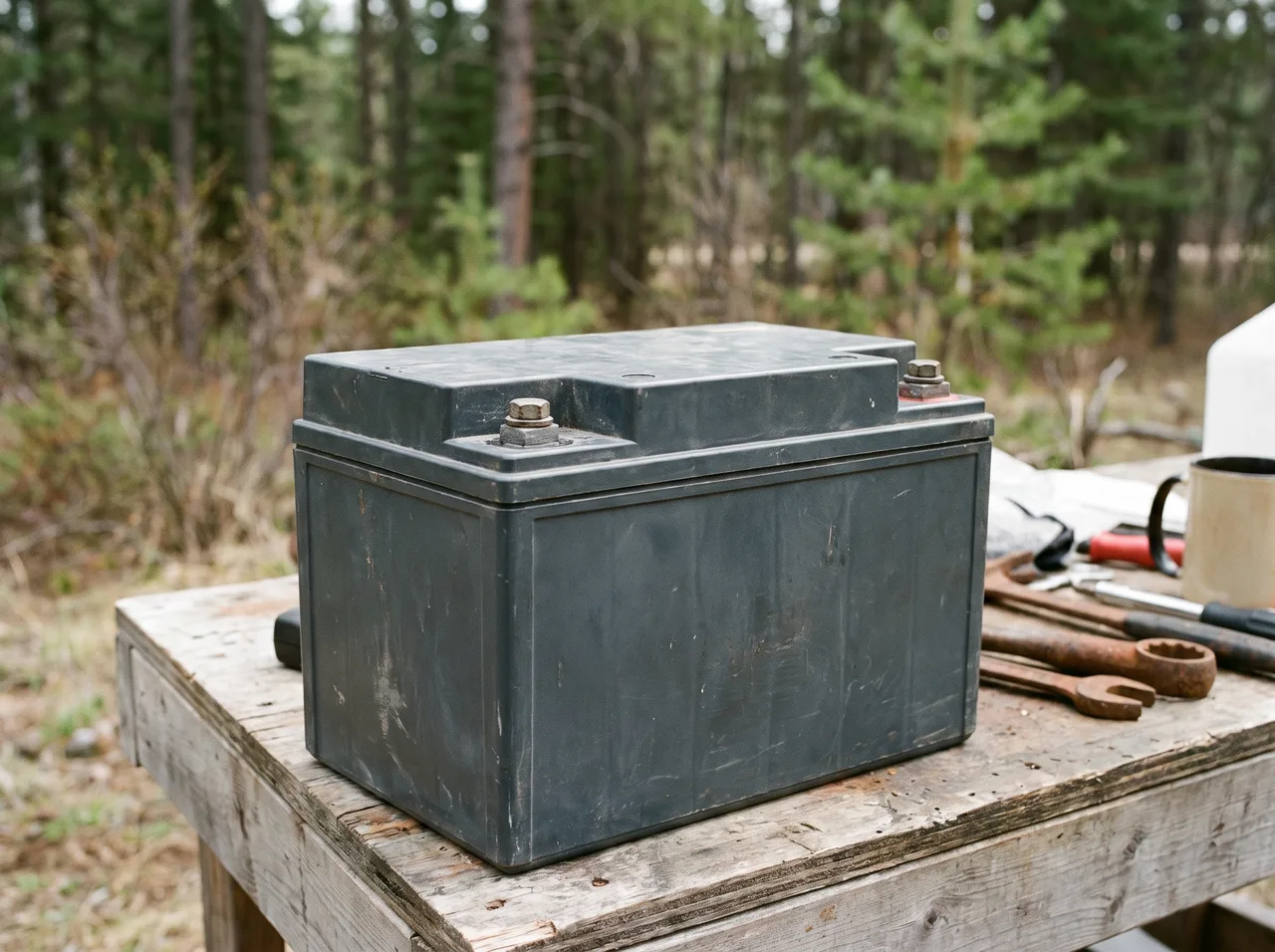
Within that family, AGM is defined by where the acid lives. Again from the same document: "AGM stands for Absorbent Glass Mat. In these batteries the electrolyte is absorbed into a glass-fibre mat between the plates by capillary action." Nothing about the lead chemistry changes. What changes is that the acid is immobilised, and almost every practical advantage below follows from that one fact.
One more spec worth knowing before you compare anything: Victron notes the rated capacity of its AGM and gel deep cycle batteries refers to a 20 hour discharge. Pull the same battery harder than that and you get less than the label says, which is a lead acid trait that catches people out when they size a bank against a big inverter load.
What changes versus a flooded battery
- No watering, ever. Trojan's AGM maintenance guidance is blunt: its AGM batteries have no free flowing electrolyte or removable vents, no watering is required, and water should never be added to them. On a flooded bank, topping up is a recurring chore you can forget and pay for.
- Sealed in normal use. Gas escapes through safety valves only on overcharge or cell failure, which is what makes AGM tolerable in enclosed spaces where an open flooded battery is a poor idea.
- Freer mounting. Trojan notes that unlike flooded batteries, its AGM units may be placed and installed upright or on their sides. In a cramped RV battery bay that is a real design freedom.
- Very low self-discharge. Victron puts its VRLA self-discharge at less than 2 percent per month at 20 degrees Celsius, doubling for every 10 degree rise, and says the batteries can be stored up to a year without recharging if kept cool.
- Strong high current delivery. Victron states its AGM deep cycle batteries have excellent high current performance and recommends them for high current applications such as engine starting.
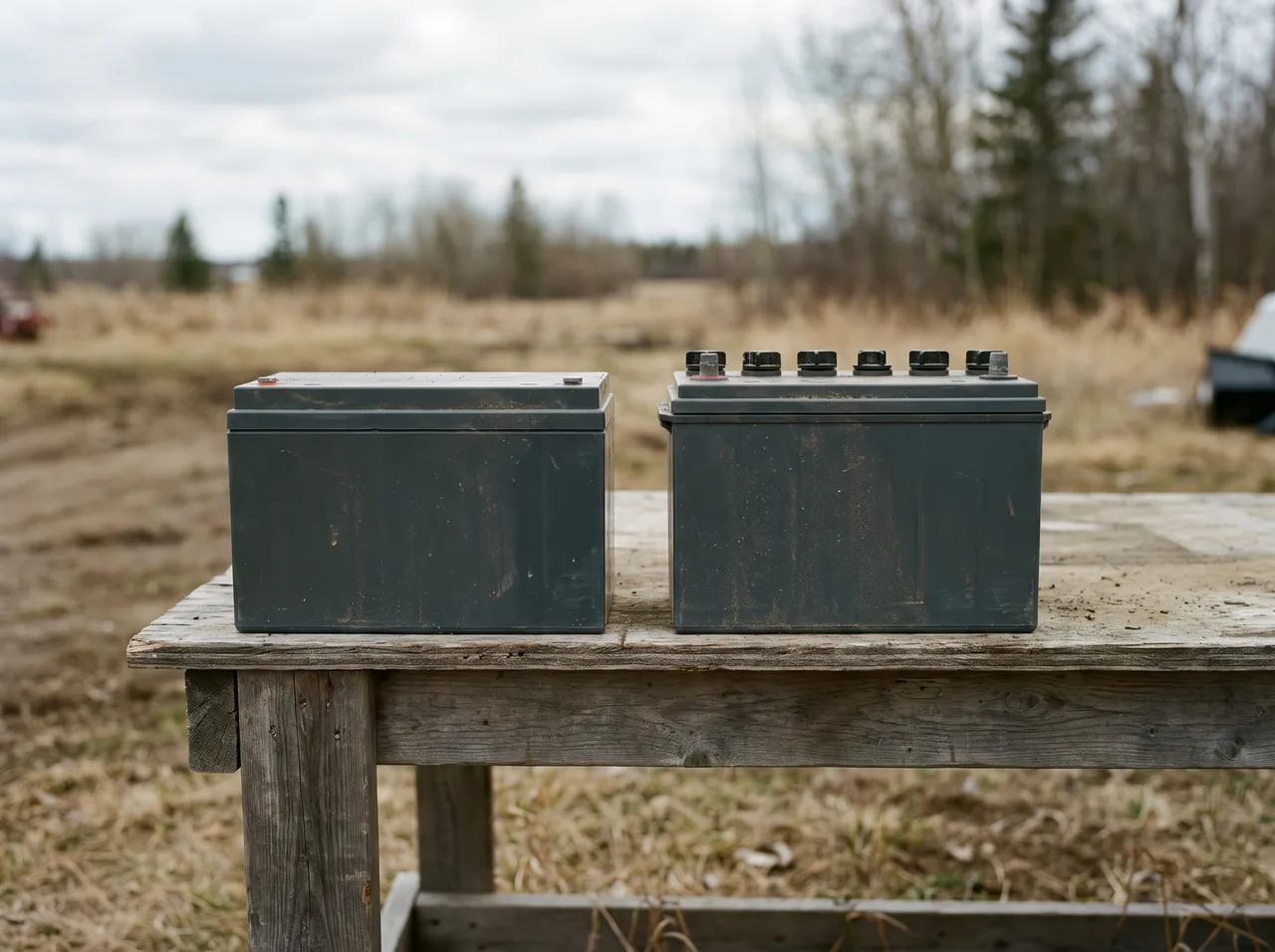
What does not change is the chemistry underneath. Victron says it plainly in the same datasheet: repeated deep and prolonged discharge "has a very negative effect on the service life of all lead acid batteries, Victron batteries are no exception". Sealing the case does not repeal that.
The number that decides everything: depth of discharge
This is the section to read twice. Victron publishes cycle life for its AGM Super Cycle battery at three different depths of discharge, and the spread is the whole story:
| How deeply you discharge it | Published cycle life | What that means in practice |
|---|---|---|
| 40 percent | At least 1000 cycles | Shallow, gentle use. You carry more battery than you strictly need and it lasts. |
| 60 percent | At least 700 cycles | Victron's recommended frequent-use band is 60 to 80 percent for this battery. |
| 100 percent | At least 300 cycles | Victron recommends full discharge only as an occasional event, not a habit. |
Source: Victron's AGM Super Cycle datasheet, read August 3, 2026. Note that this is Victron's deep-cycle-optimised AGM, built with a positive plate paste less sensitive to softening and electrolyte additives that reduce sulfation, so an ordinary AGM will generally do worse rather than better. The lesson generalises anyway: with lead acid you are not buying capacity, you are buying capacity at a depth, and the two are different purchases.
AGM is fussier about charging than people expect
"Maintenance free" describes the water, not the charger.
Trojan's guidance for its AGM range states that both under-charging and over-charging reduce battery life, and gives a useful physical tell: if fluid is present on top of an AGM battery, it may mean the battery is being overcharged. It also specifies 14.4 volts absorption and 13.5 volts float for a 12 volt system at 77 degrees Fahrenheit.
Victron's Super Cycle figures are in the same territory: absorption 14.2 to 14.6 volts, float 13.5 to 13.8 volts, storage 13.2 to 13.5 volts.
The part most owners miss is temperature. Trojan says temperature compensated charging is desirable for all batteries but "should always be used" with AGM.
Victron quantifies it: compensation is required when battery temperature is expected to sit below 10 degrees Celsius or above 30 degrees for long periods, at minus 4 millivolts per cell, which is minus 24 millivolts per degree for a 12 volt battery, centred on 25 degrees. In an RV, where the battery bay swings from freezing to baking, that is not an academic footnote.
AGM versus gel, briefly
Gel is the other sealed VRLA type, and the trade is clean enough to state in two sentences from Victron's own datasheet. Gel batteries "in general have a longer service life and better cycle capacity than AGM batteries", but have lower effective capacity at high discharge currents.
AGM, conversely, is "more suitable for short-time delivery of high currents". So gel leans towards longevity and steady loads, AGM towards punchy loads such as starting an engine or driving a large inverter.
When AGM still beats lithium
On capacity per pound and cycles per dollar, LiFePO4 wins and it is not close. We set out that case, with the manufacturers' own numbers, in LiFePO4 explained. But AGM is not a legacy product, and three advantages survive the comparison intact.
AGM still makes sense when
- Budget is the binding constraint. AGM costs a fraction of LiFePO4 per battery, and for a few weekends a year the lifetime maths never gets a chance to pay you back
- You camp in the cold. AGM has no cold-charging restriction, which is the exact limit that pushes LiFePO4 buyers towards heated models
- You keep the existing charger. An RV converter set for lead acid suits AGM; a lithium swap can mean a charging profile change too
- The load is short and heavy. Victron recommends AGM for high current applications such as engine starting
- The rig sits on shore power most of the time, where shallow cycling keeps AGM near its 1000-cycle end
AGM stops making sense when
- You boondock often, because 300 cycles at full discharge arrives faster than it sounds
- Payload is tight, since lead acid carries far more weight for the same usable energy
- You need most of the label capacity, which lead acid never gives you without shortening its life
- The battery will sit part-charged between trips, which is the condition that causes sulfation
- Charging is uncontrolled, since AGM punishes both under and over-charging
For the choice itself rather than the chemistry, our guide to the best RV battery for boondocking works through usable amp-hours and the fork most buyers get wrong. If the answer turns out to be a sealed box with outlets rather than a wired bank, what a solar generator actually is covers that, and the what will it run calculator sizes it against real appliances.
See the LiFePO4 system we benchmark against
Common questions
What is an AGM battery?
An AGM battery is a sealed lead acid battery in which the acid is held in a glass mat rather than sitting as free liquid.
Victron’s datasheet defines it directly: AGM stands for Absorbent Glass Mat, and the electrolyte is absorbed into a glass-fibre mat between the plates by capillary action.
AGM is one type of VRLA battery, which stands for Valve Regulated Lead Acid, meaning the case is sealed and gas escapes through safety valves only in case of overcharging or cell failure.
What is the difference between AGM and a regular flooded battery?
Three practical things. There is no liquid to top up, and Trojan states water should never be added to its AGM batteries. There is no open venting in normal use, because the case is sealed.
And orientation is freer: Trojan notes that unlike flooded batteries, its AGM units may be installed upright or on their sides. The chemistry underneath is still lead acid, so the cycle life penalty for deep discharge does not go away.
How long does an AGM battery last?
It depends almost entirely on how deeply you discharge it, and Victron publishes the numbers for its AGM Super Cycle battery: at least 1000 cycles at 40 percent depth of discharge, at least 700 cycles at 60 percent, and at least 300 cycles at 100 percent.
Reading those three figures together is the single most useful thing you can do before buying, because they show cycle life falling roughly threefold as you go from shallow to full discharge.
How deeply can you discharge an AGM battery?
Manufacturers give different ceilings, so read your own battery’s documentation. Trojan’s AGM maintenance guidance says not to discharge more than 80 percent, while its flooded FAQ recommends staying inside 20 to 50 percent for optimum life.
Victron recommends its Super Cycle battery for occasional discharge to 100 percent or frequent discharge to 60 to 80 percent, and notes separately that repeated deep and prolonged discharge has a very negative effect on the service life of all lead acid batteries.
Is AGM better than lithium for an RV?
Not on capacity or lifespan, but it still wins on three counts. AGM costs far less per battery.
It has no cold-charging problem, which is the limit that makes LiFePO4 owners buy heated versions. And it usually works with the charger already fitted to the RV.
If you camp a handful of weekends a year, in winter, on a budget, AGM remains a defensible choice rather than a legacy one.